Wednesday, 3 February 2010

Thriller Planning - The Story

After discussion, we decided we wanted the opening to portray both a murderer, and those trying to catch him, juxtaposing good and bad. We decided that, for the police part, we should introduce a new character, a new detective on the case. That way, as he is being familiarised with the story, so then is the audience.

The Plot
In the introduction, we see two scattered collections of photographs, one of which is the killer's, and one of which is the detective's.There have been a series of muders, and all of the victims were in the same year at school. Working on the case for two months, our detectives have narrowed down the suspects to eight, which are displayed, with annotations, on a board. They notice that one of the suspects is in the same year as them. As they are discussing this, a new character, the new cop on the case, is introduced. The two detectives tell the new guy the story of the case.
Meanwhile, our killer is introduced, washing his hands, representing his compulsion for hygiene. Hearing voices in his head, we realise that he is schizophrenic. The voice is telling him not to kill again, but he ignores it, and walks out the door.
We then see our killer waiting in a coffee shop, stirring his coffee and taking a sip. He turns around to see a man walking down the alley adjacent to the coffee shop. We see a quick flashback of the man, as one of the photographs at the beginning, and then our killer stands up and walks after him, and then it fades to black.

Storyboard
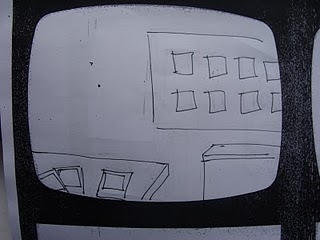
 This is our opening shot, a pan across two different sets of photographs. One set is on a light coloured table, whilst the other is on a dark one. Although not evident from this picture, we want to have one set have blue annotations on, whilst the others have red annotations. This is meant to show the difference between the killer and the detectives.


The shot then tilts up from the desk, revealing board with eight pictures of suspects on. One of the pictures is zoomed in on, the face of the killer, and then a dissolve transition is made.

The shot dissolves to the face of our killer, looking into the mirror, getting ready to kill again. From this we show the killer arguing with the voice inside his head.

When he replies to these voices, we see a different shot, further implying his schizophrenia

We see the killer exit the bathroom and walk down the stairs.

The voice inside the killer's head argues with him as he goes to leave, and stops when the killer slams the door shut.

We then cut to our two detectives at a loss about where the case is leading them. Here, they notice that one of the suspects, our killer, was in the same year at school as all of the victims, and was "unusually disruptive".

As they are talking, the head inspector walks in and introduces a third detective to the case.

We will then have the two officers telling the new one what has happened so far.

We then cut to a shot of our two police officers talking outside the police station, expressing their doubts about the new detective.

As they are talking, we see one of the victims walk past them. The camera tracks him down an alley.


We cut to the killer drinking his coffee inside a coffee shop. We see the victim walk past the window, and our killer get up and follows him.

We hope to use Café Nero for this, because the large windows would make it easier to track the victim, and have contacted them about it. However, we are awaiting reply.






Monday, 1 February 2010

"Psycho" Analysis

It is in no doubt that Alfred Hitchcock's "Psycho" is one of the landmark films in the twentieth century. This is because of the boundaries it breaks, the lengths that it went through to capture the audience. It does so in a variety of ways.
One of the best ways in which Hitchcock made this film so successful was his ability to shock the audience without the use of gore and blood. In the shower scene, for example, we see the death of Marion Crane (played by Janet Leigh), who was the main character up to this point. Looking back at the scene, I saw that there was actually very little blood, apart from that going down the plug hole, and during the "stabbing", we never once see a knife penetrating skin. One of the main ways Hitchcock was able to do this was through the musical score. His "muted strings" are still renowned today for their ability to add tension to the film.
The shower scene also presents us with another of Hitchcock's devices that broke the normal boundaries, and that was the amount of nudity used. Most nudity was not permitted in films of the '60s, or frowned upon at best. So, to have a naked woman murdered in the shower was no easy task in it's context. Also, at the start of the film, we see Janet Leigh, in a brassiere, with her lover.This is ground breaking, as previously promiscuity such as this was frowned upon. However, Hitchcock does not make a big attempt to shock the audience with graphic imagery, he simply lets it be there.
Another way in which Hitchcock broke the previous rules was his killing off of Janet Leigh, by the end of the first half of the film. We originally follow the story of her stealing $40,000 off her boss, and the detective attempting to go after her. However, when she is killed, the story of the money is buried, along with her car, when Norman Bates (played by Anthony Perkins) pushes it into the bayou. As he is packing up her things, ready to sink them into the swamp, we are constantly drawn towards the money, wrapped inside a newpaper. We wonder whether he will find it, and that tension brings us to the edge of our seats. As the money sinks with the car, we are left wondering where this story will lead us. As Janet Leigh was a major star at the time, killing her off halfway through the film seemed to be a bad thing to do, but Hitchcock made this work, and more importantly, allowed Anthony Perkins a major role that allowed us to see into the mind of the killer.
Hitchcock broke the boundaries by the twist that's introduced at the very end. Norman Bates claims to have a mother, and we hear her voice in one scene, and the tale is set up to reveal that his mother is the killer. We see this when, in the shower scene, we see that the one with the knife is a womanly shaped figure with her hair in a bun. It is also shown when Norman Bates is arguing with his mother, and taking into the the basement to "be safe". However, when Marion's sister Lila (played by Vera Miles) enters the basement and whispers "Mrs. Bates" to the old woman staring at the wall, we see that she is long dead. Just as the audience are getting their heads around this, Norman Bates enter the room in a wig and dress, with a knife in his hand. I definitely wasn't expecting this, and it's twists such as these that have given Alfred Hitchcock his legendary status.
In conclusion, I feel that Hitchcock crafted Psycho expertly to keep the audiences attention at all times. This was done through the musical score, the storyline and twists, and the contextual risqué amounts of nudity and violence.

Saturday, 30 January 2010

First Planning into our Thriller

 Towards the end of filming our continuity piece, we decided to spend a lesson discussing the sub-genre of our thriller, as well as who we could use to act, and where it could be shot.


Genre?
Crime thriller
Psychological thriller
Horror thriller
Action thriller

Possible locations?
The chase
Old St Georges
Brocton
School
The lane


Possible actors?(our friends who are willing to participate)
Ellis
Joe
James w.
James f.
Mike
Sisters, brothers, etc.
John

After discussion, we decided that it would be best to make a "crime" thriller, as the introduction could work to familiarise the audience with the "case" that would be investigated in the film. For the actors involved, we found it would be best to use our friends, and ourselves, as it's generally easier, and we don't have to pay them. In terms of location, We've written down a bunch of places that are easily accessible, and free to film on. Although not written on this paper, we decided that we would like the killer to be sitting in a coffee shop, waiting for his next victim.

Thursday, 21 January 2010

Continnuity Piece - The Result


I feel that this came out quite well, for our first filming exercise. I feel that the music at the start, Metallica's Unforgiven III, seems to emphasise the lamentable seriousness of this, but then it is lifted when The BeeGee's
Stayin' Alive starts playing. I feel that we have balanced this well, as it's not too serious, but it's not too silly.
One of the continuity errors that we came across was the different doors that were used. As the protagonist walks into the room, the door was completely different to the one in the office that he is supposed to walk into, as they were filmed in two different places. Fortunately, we realised this, and made sure that they were both filmed with the same door.

Thursday, 14 January 2010

Taking Lives Analysis

In what ways does “Taking Lives” conform to or subvert from what you believe to be the forms and conventions of the Thriller Genre?
“Taking Lives” is a 2004 thriller film in which an FBI profiler, played by Angelina Jolie, is summoned to track down a killer in Montreal, who assumes the lives and identities of the people he kills as he travels across North America. This forces Illeana to adjust to working in a strange city with a police team with which she doesn't really fit in. This film is very much a run-of-the-mill thriller that sticks pretty much within the confines of its overworked genre.
One way in which “Taking Lives” conforms to the conventions of the Thriller genre is the location. Thrillers often take place wholly or partly in exotic settings such as foreign cities, deserts, Polar Regions, or high seas. “Taking Lives”, set it Montreal, Canada, is no exception.
Another way in which “Taking Lives” conforms to the conventions of the Thriller genre is the use of an “FBI Detective” main character. The heroes in most thrillers are frequently "hard men" accustomed to danger: law enforcement officers, spies, soldiers, seamen or aviators.
Another way in which the choice of character conforms to a typical thriller would be their imperfection as a human. Most thrillers usually have a quite psyhologically detached lead character (i.e. Illeana has pictures of dead bodies on the walls about her apartment). The main character can sometimes relate to the murderer/villain (Angelina Jolie’s character killed a burglar when she was young. Another example of this would be Se7en, in which. Loads have mental issues surrounding them.
A way in which the choice of character does show subversion, however, is the use of a female as the main character, as most Thrillers traditionally have a male lead, though it is apparent that “breaking-the-mould” female lead has become rousingly popular. Examples of this would be the 1979 film “Alien” and the 1991 film “Silence of the Lambs”.
“Taking Lives” conforms to the conventions of the Thriller genre in the way that suspense is created in order to draw the audience in, through the use of non-digetic sounds, such as eerie music or, in contrast, complete silence. This is used particularly well in the scene in which Angelina Jolie’s character enters the old house, looking for clues (a cliché in itself). Whilst she is searching, there is no visible movement of anything other than Jolie. It is only when she lies down, when the audience’s mind is at rest, that a pair of hand suddenly emerge from the bed, grabbing her. This plays on the audiences fear, and adds to the enjoyment of the film as a whole.
Another way in which ““Taking Lives”” subdues to the normal conventions of a thriller would be its “big twist” at the end, the “innocent is guilty” number was easy enough to predict. This is utilised to keep the audience guessing till the very end, in which the “her pregnancy was a trap” card was well played. Another example where a twist is utilised would be “Se7en”, in which the “head in a box” scene has become particularly famous for shocking the audience.
In conclusion, I think it’s safe to agree that “Taking Lives” is a generic thriller, which conforms to most of the forms and conventions of the genre.

Research into the Thriller Genre

After our continuity piece, we were given the task to create the opening to a thriller. For this we had to research what the thriller genre actually involved. Thriller is a genre of fiction in which tough, resourceful, but essentially ordinary heroes are pitted against villains determined to destroy them, their country, or the stability of the free world. Part of the allure of thrillers comes from not only what their stories are about, but also how they are told. High stakes, non-stop action, plot twists that both surprise and excite, settings that are both vibrant and exotic, and an intense pace that never lets up until the adrenalin packed climax.

As James Patterson, a successful American author of thriller novels, explains:
"Thrillers provide such a rich literary feast. There are all kinds. The legal thriller, spy thriller, action-adventure thriller, medical thriller, police thriller, romantic thriller, historical thriller, political thriller, religious thriller, high-tech thriller, military thriller. The list goes on and on, with new variations constantly being invented. In fact, this openness to expansion is one of the genre's most enduring characteristics. But what gives the variety of thrillers a common ground is the intensity of emotions they create, particularly those of apprehension and exhilaration, of excitement and breathlessness, all designed to generate that all-important thrill. By definition, if a thriller doesn't thrill, it's not doing its job."
General Forms and Conventions of a Thriller

  • Thrillers often take place wholly or partly in exotic settings such as foreign cities, deserts, polar regions, or seas. Examples of this would be Ridley Scott's "Alien", as it is set on a spaceship.
  • In a thriller, the hero must thwart the plans of an enemy, rather than uncover a crime that has already happened; while a murder mystery would be spoiled by a premature disclosure of the murderer's identity, in a thriller the identity of a murderer or other villain is typically known all along. Before the eventual defeat of the villain, there is usually an emotional battle between the protagonist and the antagonist.
  • The antagonist is usually very well versed in technology and is often highly trained in terms of resilience and battle skills. This means that there are lots of action scenes, which usually keep the audience interested.
  • Suspense and tension are used extensively, to keep the audience on the edge of their seat. Also, twists are often used in the story to keep the audience guessing, as well as forcing the audience to think.
  • There is typically a male protagonist, although women have become increasingly common. Examples of this would be Angelina Jolie in "Taking Lives" and Sigourney Weaver in "Alien".
  • The audience is often able to relate to the protagonist, as they are normally shown to have human flaws and weaknesses, however accustomed the character is to danger. Sometimes the protagonist is even an everyday person who has been drawn into the danger.
Sub-Genres
The thriller genre can include the following sub-genres, which may include elements of other genres:
  • Action Thriller
  • Conspiracy Thriller
  • Crime Thriller
  • Psychological Thriller
  • Disaster Thriller
  • Horror Thriller
  • Erotic Thriller
  • Political Thriller
  • Supernatural Thriller
  • Sci-fi Thriller
  • Spy Thriller
  • Drama Thriller
  • Legal Thriller

Sunday, 3 January 2010

Planning for our Continuity Piece

For our first piece of film, we have been set to produce a simple continuity piece, to help familiarise us with different camera angles, shots and movements. It's also a good way to develop skills in continuity editing. The most basic example of this would be a man walking up to a room, exchanging a line of dialogue, then leaving.

The Plot for our Piece


For our piece, we decided to use the basics of the example that was given to us, but add a little extra to it.
Our protagonist is walking along a corridor. This is because his pen has run out, and needs to go to the next office (the antagonist's office) to get one. When our protagonist reaches the office and asks for a pen, the antagonist responds violently, and grabs our character by the collar. The protagonist is then thrown out of the office, but we can see in his hand that he has managed to take a pen from the desk. Our hero then walks smugly back to his office, and jumps down the steps in ecstasy.

 The Storyboard
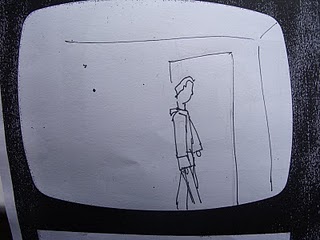
 This first shot shows the protagonist walking down a corridor, in order to retrieve the pen.

This shot shows our walking man from a side-on angle, inferring it is shown from another office within the building. The door arch helps to frame the shot nicely.

  Now we can finally see the protagonist's face, we are given the nervous expression on his face. This gradual bleeding of information helps to intrigue the audience further.

 Shot from the top-right hand corner of the corridor, we switch to a CCTV shot that tracks our character around the corner of the corridor.

From around the corner, we see our protagonist enter the antagonist's office...

 ...and as he opens the door, we switch to a shot from inside the office as he walks through to the desk.
 
 Here, we decided to use an over-shoulder shot, as our protagonist asks the in inhabitant of the office "Can I borrow a pen?" The antagonist then swivels around on the chair, so he is to the left of the protagonist's shoulder. Although we wanted to display the antagonist from a lower camera angles, to convey him as in power, it was hard to achieve, seeing as he was sitting down.

The next shot shows the antagonist rising from his chair, grabbing our hero by the collar...

...and is subsequently thrown out of the office. This shot appears to be looking round the corner, and our protagonist falls after a few seconds of that still shot, represented a calm before the storm. We can see from this shot that the hero has got the pen in his hand, and has completed his quest.

We see the protagonist getting up...

...and then we switch to his smug face, showing the audience he is pleased in achieving his goal.

Different shots are then used to show him going down the corridor back to his office.

 This is our final shot: Our protagonist jumps down the stairs in delight. The shot freezes as he is in mid air, and slowly fades to black, and the credits will then roll.
For the music, we have agreed that we would like some kind of melancholy music for the first part of the film, followed by a happier piece after he has retrieved the pen, and his smug face is shown.